

Updated September 2026.
The Artificial Intelligence ship continues full steam ahead. From big tech giants to startups, everyone is riding the AI wave. One of these companies is Pareto, which created Tess AI (now branded simply as TESS) to serve as a hub for generative AI models and business agents.
We at Amicatek migrated from our ChatGPT Plus plan to Tess AI, and we still use it every day. In this review we share how the experience has been and what has changed since the first version of this article. Disclosure: we are a Pareto partner and the link above is an affiliate link.
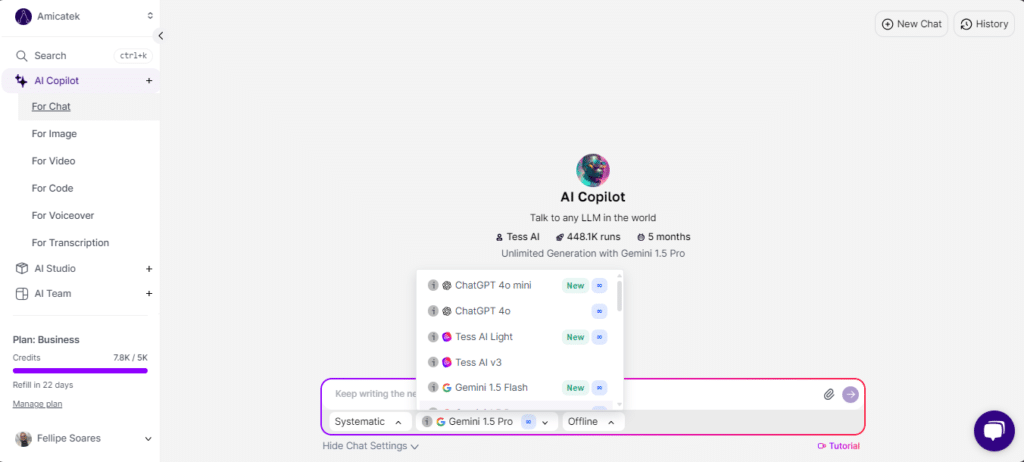
What is Tess AI?
Tess AI is an artificial intelligence platform developed by Pareto that brings multiple AI models and autonomous agents into a single workspace. Unlike standalone AI tools, it is designed for businesses and teams: plans are priced per workspace, not per seat, with credits shared across unlimited users.
The platform offers:
- Multi-model chat: access to 250+ models from OpenAI, Anthropic, Google, Meta, Mistral, DeepSeek and xAI, switching models mid-conversation
- Text, image, video and audio generation, plus transcription and translation
- AI agents: autonomous agents (which Pareto calls “Human AIs”) that run tasks for specific business roles, plus a studio to build and publish your own
- Agent Computer: lets an agent operate a computer to complete tasks
- Organizational memory and knowledge bases: files, brand assets and websites your agents can draw on
- Integrations: native connectors (Gmail, Google Drive, Slack, HubSpot, Salesforce, Notion and more), Zapier, n8n, webhooks, an OpenAI-compatible API and an MCP server
What sets Tess AI apart is its focus on business applications rather than general-purpose chatting. It is built to help companies put AI to work across multiple departments.
Is Tess AI Legit or a Scam?
Short answer: yes, Tess AI is legitimate. Pareto is a Brazilian company that, according to press coverage from March 2026, raised a US$5 million seed round led by Hi Ventures, reported more than 16,000 paying customers, and is moving its leadership to Silicon Valley to expand internationally. Its customers include brands such as Reserva, Petz and Hypera, and it is listed with reviews on G2 and Gartner Peer Insights.
Our Review: Tess AI vs. ChatGPT
First, let’s outline the purpose of each tool. ChatGPT started as a tool for individual users and now also offers business plans. Pareto’s Tess AI was designed from day one for companies and teams.
The great benefit of Tess AI for a company’s daily operations is being able to use many Artificial Intelligence models in one place. With a single login, we generate text, images, videos, audio transcriptions and translations. With ChatGPT, we are limited to OpenAI’s models, which are excellent, but come from a single vendor.
That flexibility matters in practice. In our coding routines, for example, Anthropic’s models worked better for us than OpenAI’s, while for other tasks we prefer Google or OpenAI models. Subscribing to each vendor separately would mean paying several subscriptions; on Tess they all live in one plan, consuming credits.
Data Privacy
Data privacy is also a significant factor. On Tess, work is organized in workspaces with role-based access, and the platform states LGPD compliance and GDPR readiness. More advanced controls, such as SAML SSO, SIEM audit events and custom privacy terms, are part of the Enterprise plan.
In the first version of this review we said ChatGPT only protected sensitive data on Enterprise plans. That is no longer accurate: on ChatGPT Business and Enterprise, OpenAI does not train on your business data by default. On individual plans (Free, Go, Plus and Pro), conversations may be used for training, but you can opt out in the data controls. In short, both tools now offer adequate protection for businesses, as long as you pick the right plan and settings.
AI Agents
A standout feature of Tess AI from the start was the ability to create personalized assistants trained with the specifics of your business. I used GPTs a lot in ChatGPT, so it was handy to have the same thing in Tess.
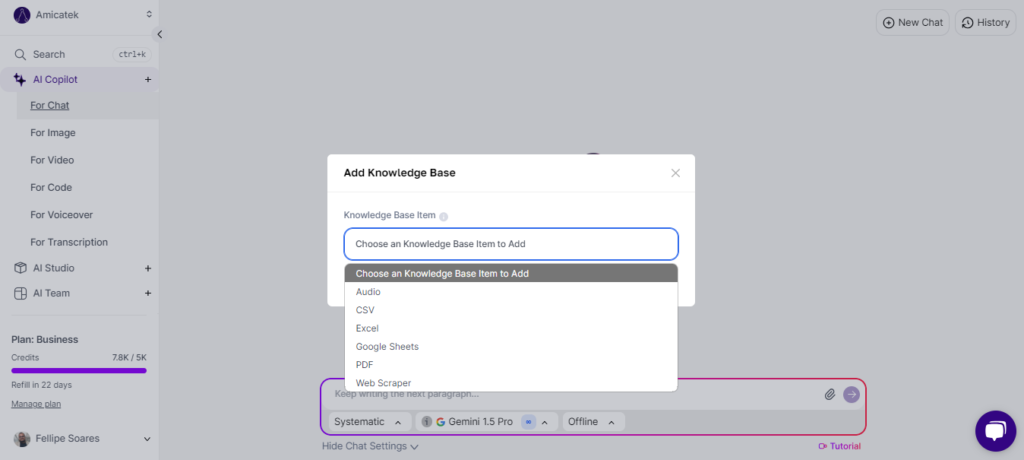
The platform has since moved much further in that direction: autonomous agents that take on specific roles, an agent studio, the Agent Computer and a shared organizational memory. Knowledge bases are still there, so you can feed conversations and agents with files and websites.
Not All Roses
ChatGPT still has an edge in simplicity: the interface is more straightforward and the learning curve is gentler for beginners. Tess AI, with so many models, agents and settings, can feel intimidating at first. The credit system also deserves attention, since more advanced models consume more credits.
Integrations have changed a lot. When we first wrote this review, Tess only connected to Zapier. Today it offers native connectors, Zapier and n8n integrations, webhooks, an OpenAI-compatible API (so tools like Make can call it via HTTP) and an MCP server. ChatGPT has also added connectors and apps, so both sides are well covered now.
Pricing
Both tools have changed their plans since the first version of this article. As of September 2026:
| Plan | Price | Best for |
|---|---|---|
| ChatGPT Go | $8/month | Basic individual use, higher limits than Free |
| ChatGPT Plus | $20/month | Advanced individual use |
| ChatGPT Business | $25 per user/month ($20 billed annually), 2-user minimum | Teams; no training on business data by default |
| Tess AI Professional | $20.83/month billed annually | One workspace, unlimited users, 4,000 credits/month, agents and API |
| Tess AI Business | $41.67/month billed annually | Everything in Professional plus team workspace, role-based access, credit caps and analytics |
| Tess AI Enterprise | Custom | SSO, audit events, advanced privacy and SLA |
The key difference is the billing model: ChatGPT Business charges per user, while Tess charges per workspace with credits shared across as many people as you want. For a small team, that usually tips the scale toward Tess. Monthly billing is also available on the Tess website, but it costs more than the annual plan.
Conclusion
Weighing the pros and cons, the switch to Tess AI has proven to be the right call for us at Amicatek. It’s like we’ve swapped a Swiss army knife for a complete toolbox. It takes a while to learn everything, but once you get the hang of it, having every model and your agents in one place makes a real difference.
And this has been the trend for SMEs: all-in-one tools that save time and boost productivity.
When we first wrote this review, we expected Pareto to improve its assistants and integrations. That is exactly what happened: the platform now revolves around autonomous agents, added native connectors and an MCP server, and the company raised new funding in 2026 to expand internationally.
OpenAI, on the other hand, remains focused on pioneering its own models, which are also available inside Tess.
In the end, the choice between ChatGPT and Tess AI depends on your profile and needs. If you are an individual user looking for smart conversations and simple tasks, ChatGPT Go or Plus may be enough.
But if you are looking for a more versatile solution for your business, with many models, agents and a single plan for the whole team, Tess AI definitely deserves a chance.
This review is based on hands-on experience using Tess AI for business applications at Amicatek. We are a Pareto partner and some links are affiliate links; we maintain editorial independence and provide honest assessments of all tools we review.